A Vertical Farming and Soilless Cultivation Technologies for Urban Food Security
DOI:
https://doi.org/10.53762/grjnst.04.03.08Keywords:
vertical farming, soilless cultivation, hydroponics, aeroponics, aquaponics, urban food security, LED lighting, AI climate control, water-use efficiency, nutrient film technique, integrated pest management, carbon footprint reductionAbstract
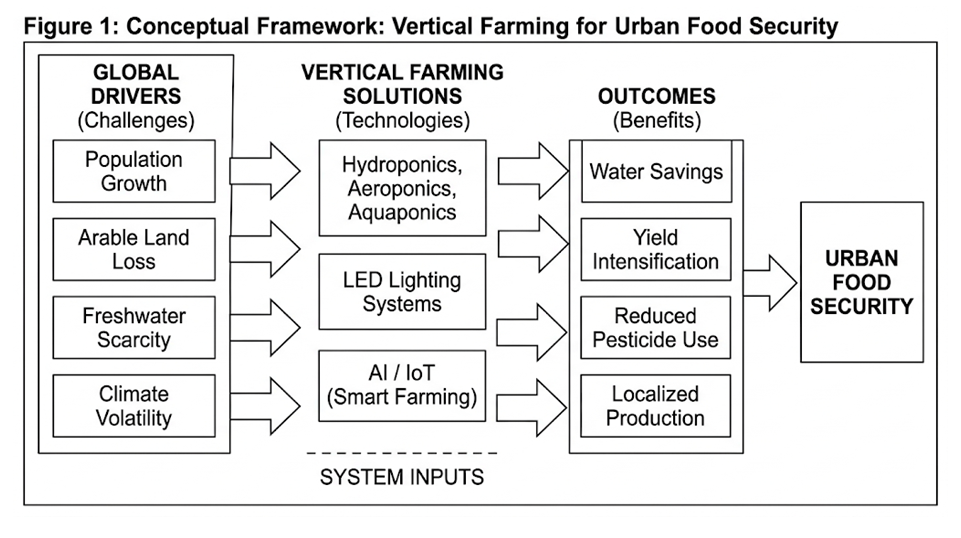
Vertical farming and soilless cultivation technologies represent a paradigm shift in urban agriculture, addressing the challenges of feeding a projected 9.7 billion global population by 2050 amid arable land loss (1.8–2.4% annually), freshwater scarcity (70% agricultural use), and climate volatility. This review synthesizes advancements in hydroponics, aeroponics, and aquaponics decoupling production from soil via nutrient film technique (NFT), deep water culture (DWC), and vertical stacking enabling year-round yields up to 390 times higher than traditional methods per unit area, with 70–95% water savings and reduced pesticide needs. Key innovations include LED-optimized spectral lighting (e.g., red:blue ratios for photosynthesis), AI-driven climate control (sensors for pH, EC, CO₂), and integrated pest management (IPM) with beneficial microbes. Economic analyses indicate viability in urban settings (ROIs of 3–5 years for leafy greens), while environmental benefits encompass lower carbon footprints (via localized production) and enhanced food security in megacities. Challenges like high energy demands (addressed by renewables) and initial costs are mitigated through modular designs and subsidies. The integration of these systems promises resilient, localized food chains, aligning with SDGs for zero hunger and sustainable cities.
Downloads
Published
Issue
Section
License
Copyright (c) 2026 Gul Muhammad shah (Corresponding author), Murtaza Ali , Iqra Sultan Rajput, Mir Baqar Raza Talpur (Author)

This work is licensed under a Creative Commons Attribution-NonCommercial-NoDerivatives 4.0 International License.