Adversarial Machine Learning Research: Modeling Attack Vectors and Developing Robust Defense Strategies for AI Systems
DOI:
https://doi.org/10.53762/grjnst.03.01.31Keywords:
Adversarial attacks, Artificial intelligence, Defense strategies, Machine learning, Model robustness, VulnerabilityAbstract
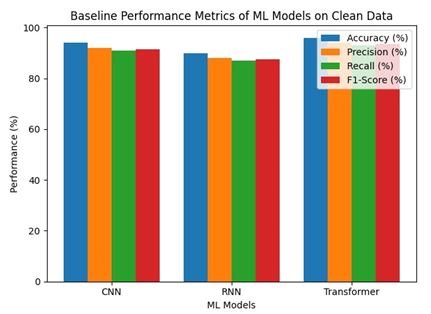
Adversarial Machine Learning (AML) has emerged as a critical area of research due to the vulnerability of artificial intelligence systems to intentionally crafted perturbations. This study investigated the impact of adversarial attacks on widely used machine learning models, including Convolutional Neural Networks (CNNs), Recurrent Neural Networks (RNNs), and Transformer architectures, and evaluated the effectiveness of different defense strategies. Experiments were conducted using benchmark datasets, where adversarial examples were generated through techniques such as the Fast Gradient Sign Method (FGSM), Projected Gradient Descent (PGD), and Carlini-Wagner (CW) attacks. Results indicated significant performance degradation in terms of accuracy, precision, recall, and F1-score across all models under adversarial conditions, with CW attacks causing the most pronounced reductions. Defense mechanisms, including adversarial training, feature squeezing, and defensive distillation, were implemented to enhance model robustness. Findings showed that adversarial training consistently provided the greatest improvement, although no single defense fully restored models to baseline performance. The study emphasized the importance of hybrid and adaptive defense strategies, along with continuous monitoring and threat modeling, to mitigate adversarial risks effectively. The outcomes of this research contribute to understanding vulnerabilities in AI systems and inform the development of more resilient models in critical domains such as cybersecurity, autonomous systems, and financial applications. Overall, the study highlights the necessity of integrating robust defense mechanisms and dynamic evaluation frameworks for secure and reliable artificial intelligence.
Downloads
Downloads
Published
Issue
Section
License
Copyright (c) 2025 Abdul Musawer Zahedi, Muhammad Jalil Afridi (Author)

This work is licensed under a Creative Commons Attribution-NonCommercial-NoDerivatives 4.0 International License.