High-Efficiency Chromium (VI) Removal from Contaminated Water Using Laboratory-Synthesized Nano-Ferrihydrite
DOI:
https://doi.org/10.53762/grjnst.03.03.47Keywords:
Chromium(VI), Nano-ferrihydrite, Water contamination, Sorption kinetics, Isotherm modeling, Eco-friendly remediationAbstract
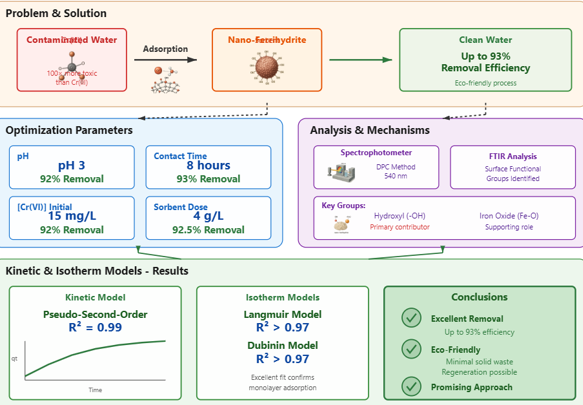
Chromium (Cr) is one of the 16th most determined toxic heavy metals globally, with hexavalent chromium (Cr(VI)) being 100 times more toxic than its trivalent form (Cr(III)) due to its better solubility and mobility in water. As a result of industrial activities, Cr is released into the environment, which poses a significant threat to human health. Therefore, this study examined the efficacy of laboratory-synthesized nano-ferrihydrite for eliminating Cr(VI) from contaminated water in relation to initial Cr(VI) concentration, contact time, pH and sorbent dose. The absorption of Cr(VI) was analyzed using the 1,5-diphenylcarbazide (DPC) method using a spectrophotometer at 540 nm wavelength. Batch sorption experiments revealed that the highest sorption capacity occurred at pH 3, achieving a sorption rate of 92%. At 8 hours of contact time, maximum sorption with a 93% removal rate was observed. At a Cr(VI) concentration of 15 mg L-1, the highest sorption efficiency remained 92%. Additionally, an optimal sorbent dosage of 4 g L-1 resulted in a maximum sorption efficiency of 92.5%. Kinetic modeling supported the pseudo-second-order model (R² = 0.99), while the isothermal data fit well with the Langmuir and Dubinin models (R² > 0.97). Analysis by Fourier Transform Infrared Spectroscopy (FTIR) highlighted involvement of hydroxyl and iron oxide surface functional groups, with hydroxyl groups primarily contributing to chromate adsorption. Moreover, the eco-friendliness of the sorption process, which produces minimal solid waste and enables regeneration, makes it a promising approach for Cr(VI) removal. This sorption study concluded that nano-ferrihydrite had excellent removal efficiency for Cr(VI) from contaminated water.
Downloads
Downloads
Published
Issue
Section
License
Copyright (c) 2025 Muhammad Sufhan Tahir, Ali Raza Khan, Aftab Alam, Nadeem Jan, Amir Arshad, Qaiser Ali Sultan, Dr Farrukh Bashir, Muhammad Akash Khan , Noman Basheer, Muhammad Shoaib, Mohammad Aslam (Author)

This work is licensed under a Creative Commons Attribution-NonCommercial-NoDerivatives 4.0 International License.