Green Cyber security: Designing Low-Energy, Carbon-Aware Threat Detection Frameworks
DOI:
https://doi.org/10.53762/grjnst.03.01.68Keywords:
Carbon-aware computing, Cyber security sustainability, Energy-efficient IDS, Green computing, Machine learning, Threat detection frameworksAbstract
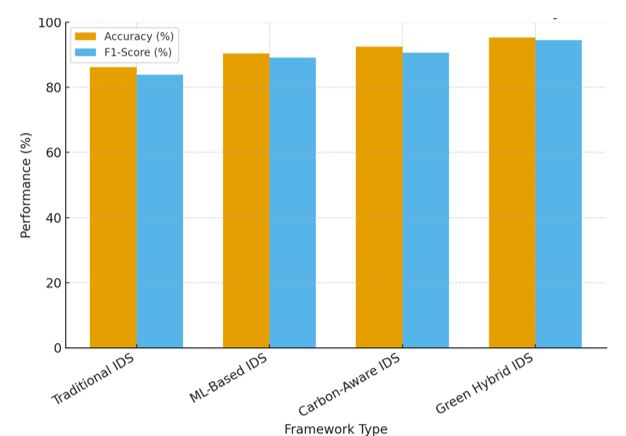
This study explored the design and implementation of a low-energy, carbon-aware threat detection framework aimed at enhancing sustainability in cyber security operations. The research focused on developing a Green Hybrid Intrusion Detection System (IDS) that combined energy-efficient machine learning algorithms with carbon-intensity-based scheduling to minimize environmental impact while maintaining high detection accuracy. Quantitative analyses demonstrated substantial reductions in energy consumption and carbon emissions, achieving up to 37.6% energy savings compared to conventional models. The proposed framework also recorded superior performance metrics, including a 95.3% detection accuracy and a 3.8% false positive rate, highlighting its efficiency and reliability. The findings indicated that incorporating environmental awareness into cyber security systems could yield dual benefits—reducing the carbon footprint of data protection processes and improving operational responsiveness. Moreover, the study established that sustainability and cybersecurity goals are not mutually exclusive but can coexist through optimized computation and adaptive threat management. These results provide a foundation for rethinking cybersecurity architectures in alignment with global sustainability targets. The study further recommended the adoption of energy-aware design principles in cyber security governance, the establishment of green security standards, and expanded real-world testing in cloud, IoT, and industrial networks to ensure scalability and resilience of eco-efficient cyber security frameworks.
Downloads
Downloads
Published
Issue
Section
License
Copyright (c) 2025 Rana Abdul Sami Khan, Anam Ahsan, Shahbaz Ali Shahani, Abdul Qiyas (Author)

This work is licensed under a Creative Commons Attribution-NonCommercial-NoDerivatives 4.0 International License.