Response of Different Bread Wheat Genotypes under Water Deficit Conditions
DOI:
https://doi.org/10.53762/grjnst.03.02.29Keywords:
Wheat, water deficit, physiological parameters, ANOVA, CorrelationAbstract
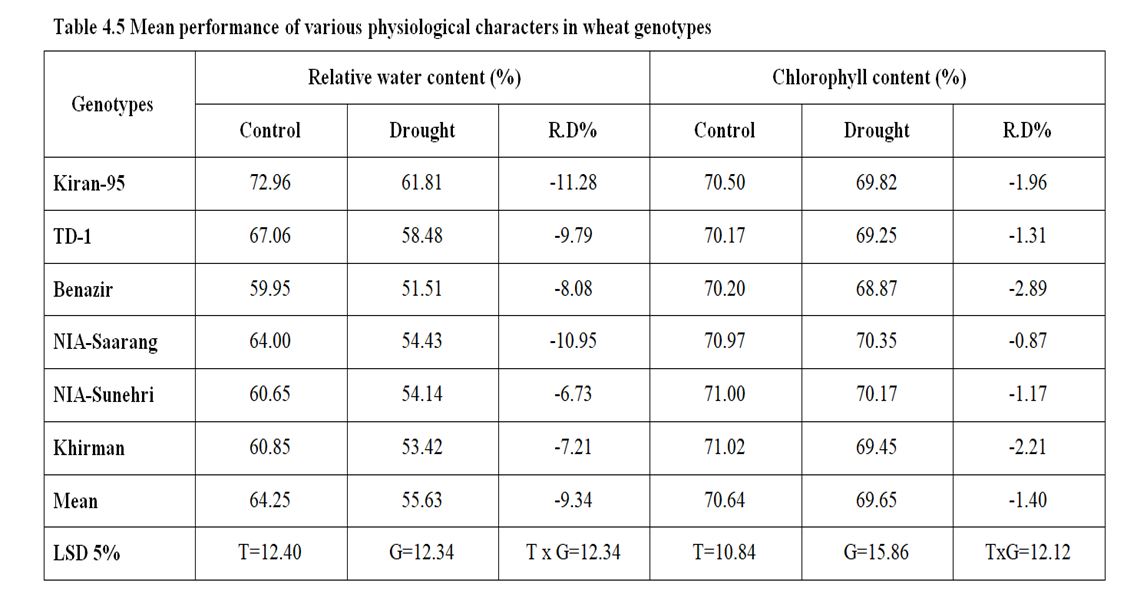
Wheat is a crop that is considered to be essential since it is utilized in the production of a wide range of various meals. This investigation was conducted out at the Nuclear Institute of Agriculture (NIA), located in Tandojam, during the years 2021-22. The results of an ANOVA performed on wheat showed significant differences between treatments, genotypes and the interaction (genotype x treatment) for plant height, productive tillers plant-1, spike length in centimeters, spikelet number per plant, grain yield plant-1, biological yield plant-1, and harvest index in percentage. These variables were measured in terms of wheat. In terms of physiological characteristics, such as relative water content (%), chlorophyll content (%), and leaf area (cm2), there was also a significant association between genotypes, treatments, and the interaction. This relationship was significant at the P0.01 level. Despite this, there were a few small characters who you may engage with. Benazir and Khirman plants grown under circumstances of control and drought had, on average, lower plant heights and more tillers than those grown under conditions of drought alone. Longer rises were recorded in TD-1 and NIA-Sunehari. It was observed that NIA-Sunehri and Khirman were producing an increasing number of spikelets. Khirman often has a higher seed index than the other cities. In spite of the drought, the grain harvests in Benazir and Khirman were much greater. Kiran-95 and NIA-Sunehri cultivars produced the highest levels of biological output. At the NIA-Saarang location, the harvest index reached its highest point. The TD-1 and NIA-Sunehri strains both have bigger leaf areas. According to the findings of the researchers, individuals with the Kiran-95 and TD-1 genotypes often had greater levels of RWC. Under both normal and dry conditions, the NIA-Saarang and NIA-Sunehri genotypes exhibited significantly greater chlorophyll content percentages. As a result, the Benazir, Khirman and NIA-Sunehri genotypes have the potential to be used in the near or far future as drought-resistant breeding stock.
Downloads
Downloads
Published
Issue
Section
License
Copyright (c) 2025 Muhammad Ammar Ansari , Manzoor Ali Magsi , Qamaruddin Jogi, Mehran Ali Chahwan (Corresponding author), Muhammad Haroon Hullio, Shabana Naz Mazari , Abdul Hakeem, Mehtab Ahmed , Shafait Ali Jogi (Author)

This work is licensed under a Creative Commons Attribution-NonCommercial-NoDerivatives 4.0 International License.