Advances in Genomic-Assisted Breeding for High-Yield and Climate-Resilient Wheat
DOI:
https://doi.org/10.53762/grjnst.03.03.25Keywords:
genomic selection (GS), genome-wide association studies (GWAS), CRISPR-Cas9, climate resilience, drought tolerance, heat stress, disease resistance, genetic diversity, landraces, wild relatives, sustainable agriculture, yield improvement, grain quality, global collaboration.Abstract
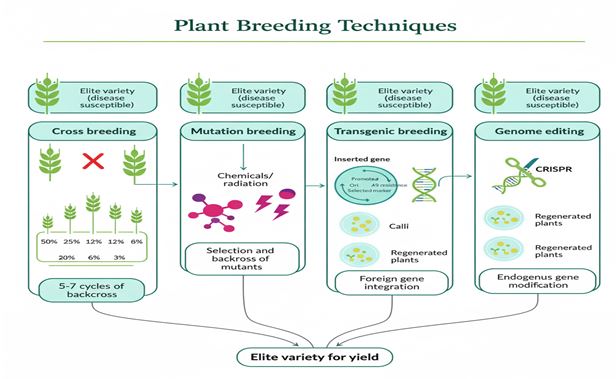
Wheat (Triticum spp.) is a staple food crop important for global food security, providing essential calories and proteins to billions of people. However, wheat production faces numerous challenges due to climate change, in the form of droughts, heat stress, and extreme weather events. This review synthesizes advances in genomic-assisted breeding that are used to develop climate-resilient varieties of wheat for high-production. Advanced molecular breeding methods such as genomic selection, marker-assisted selection breeding, genome-wide association studies method, and CRISPR-Cas9 gene editing methods are compared with traditional methods. Advance breeding methods enhance precision in breeding, accelerate genetic gains, and target various complex traits like drought tolerance, heat resistance, disease immunity, and grain quality of crop. Further, Genetic resources from wild relatives are discussed for broadening diversity and introgression stress-resistant alleles. Case studies demonstrate successful applications, including doubled genetic gains via GS and improved yield-protein trade-offs. Challenges, such as the wheat genome's complexity, high phenotyping costs, and resource limitations in developing regions, are addressed, alongside future directions involving multi-omics integration, artificial intelligence, and global collaborations (CIMMYT). Ultimately, genomic-assisted breeding offers a transformative strategy to sustain wheat productivity amid environmental pressures, ensuring long-term food security.
Downloads
Downloads
Published
Issue
Section
License
Copyright (c) 2025 Bahar Ali, Aisha Irshad, Urooj Mithal, Mohammad Hashim Faryad, Zubair Ahmed Baloch, Muhammad Suleman, Adalat Ali, Ayesha Rehman Laghari , Shahab Atta (Author)

This work is licensed under a Creative Commons Attribution-NonCommercial-NoDerivatives 4.0 International License.