
Smart Transportation Systems: Enhancing Traffic Flow and Reducing Urban Congestion through Intelligent Solutions
DOI:
https://doi.org/10.53762/grjnst.04.03.03Keywords:
Artificial intelligence, intelligent transportation systems, IoT integration, smart mobility, traffic flow efficiency, urban congestionAbstract
Smart Transportation Systems emerged as an effective solution for improving traffic flow efficiency and reducing urban congestion through intelligent and data-driven technologies. This study examined the impact of real-time traffic monitoring, intelligent traffic signal control, artificial intelligence-based predictive analytics, and IoT-enabled data integration on urban mobility outcomes. A quantitative research design was applied, and data was collected from a sample of 300 respondents, including transportation professionals, urban planners, and daily commuters. Descriptive statistical analysis was used to evaluate the effectiveness of Smart Transportation System components. The results indicated that real-time traffic monitoring recorded the highest mean value (M = 4.12), followed by traffic flow efficiency (M = 4.10), intelligent signal control (M = 4.05), and urban congestion reduction (M = 4.03). AI-based predictive analytics (M = 4.01) and IoT-enabled data integration (M = 3.98) also demonstrated strong positive contributions to traffic optimization. The findings showed that Smart Transportation Systems significantly improved travel time, reduced intersection delays, enhanced vehicle movement, and minimized congestion during peak hours. The study concluded that intelligent transportation technologies played a crucial role in enhancing urban mobility and supporting sustainable transportation development. The results provided valuable insights for policymakers and urban planners to design efficient, technology-driven traffic management systems for modern cities.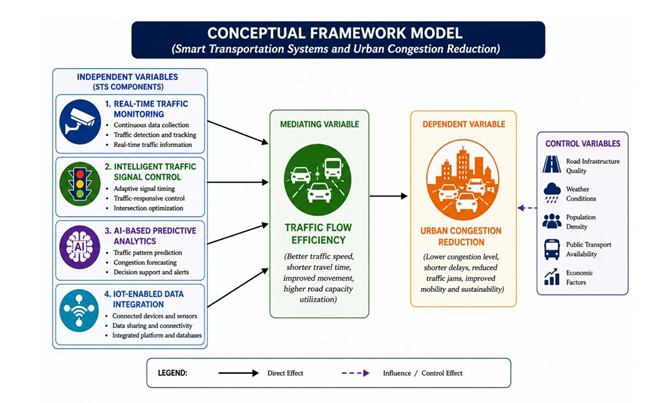
Published
2026-05-09
Issue
Section
Articles
License
Copyright (c) 2026 Muhammad Bilal Israr, Zafreen Elahi, Anwaar Hazoor Ansari, Ahtsham Mustafa Awan (Author)

This work is licensed under a Creative Commons Attribution-NonCommercial-NoDerivatives 4.0 International License.


